
In spell circles, the order that the spell circles were triggered in stays as the order that they are executed in for the future. This means that if we can get the ordering to be what we want for *just the tick of activation*, we can be absolutely sure that this will stay the case, given that no spell circles die.
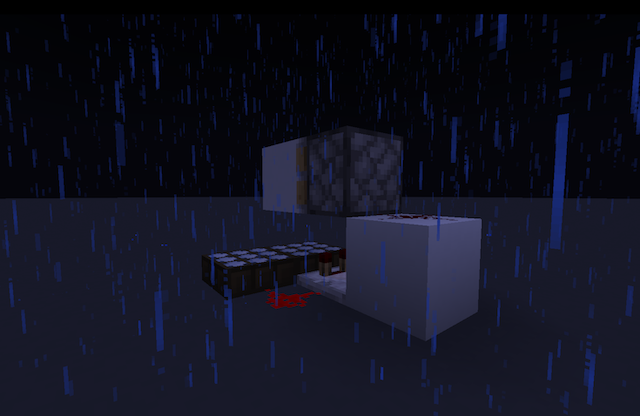
To get far-apart locations to synchronise like this, we will first have to obtain a synchronised clock. Daylight Sensors have a not-at-all-obvious usage here; they are updated once every second, on a global timer. This means that two daylight sensors an arbitrary distance apart will update at the exact same time. Combine this with obstructing the daylight sensor (alters the signal it provides) constantly, and we can obtain a clock, for which every instance updates at the same time, like so (the comparator is on subtract mode):
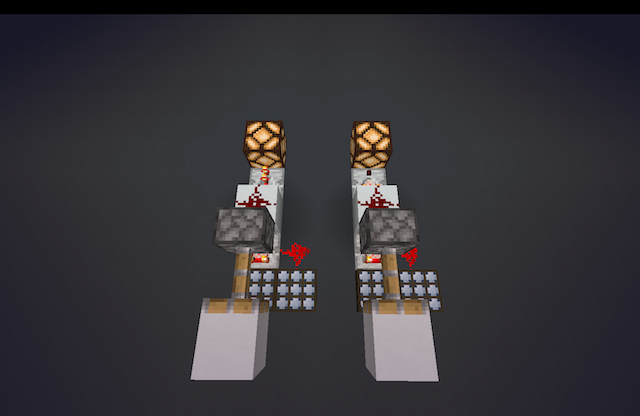
By taking advantage of the fact that repeaters update before comparators in a tick, we can get two different clocks to trigger one after the other, but in the same tick. In this figure, the light on the left will trigger before the one on the right (though you can't see it because it happens too fast):
You can also chain the repeaters and comparators to allow you to get more granularity than just two outputs, in which case the order is represented by binary (each comparator is a 1, and each repeater is a 0), with the smallest bit closest to the white concrete with the dust on top, like so:
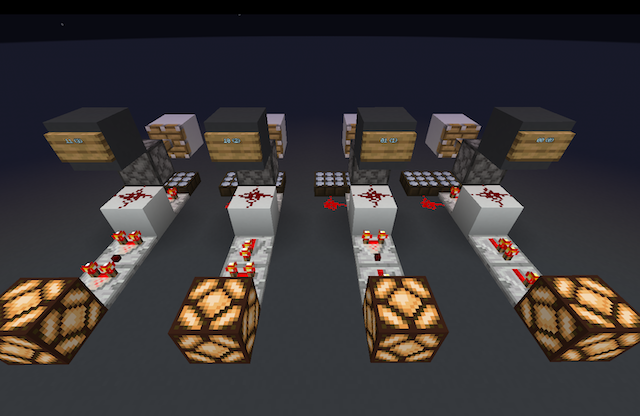
In this picture, the lamps power from right to left, and, from left to right, their binary representations are 11 (3), 10 (2), 01 (1), and 00 (0). Coincidentally, this matches up perfectly to the order of execution, and this scales up infinitely.
Now, let us apply this to spell circles! we'll use our clock as shown before and some spell circles, so we can power them up in order. In this image, do not worry about the hex in the circles. They are only there to reveal increasing numbers from one to four (inclusive) from left to right, in the order of execution:
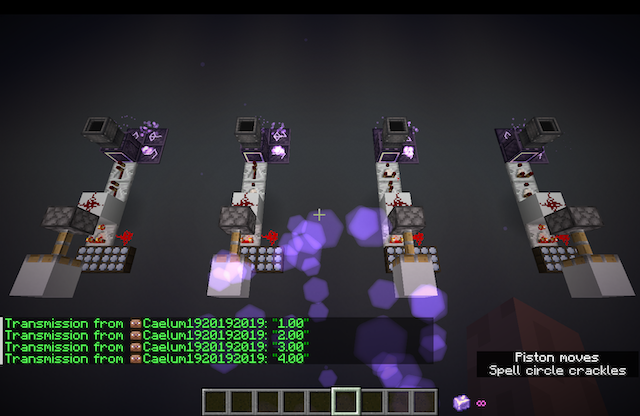
So we've done it! We've successfully ordered our spell circles, such that they execute in an order of our choosing. But what use does this have beyond being able to chain together hexes for some odd reason? I have a use case I will personally be using; say we have two impetii which execute one after the other, circle A and circle B. Circle A has ambit over position C, but circle B does not. Circle B would like to do something with position C, so circle A, knowing that it executes before circle B, summons a greater sentinel at position C. Then, circle B executes, and it knows that circle A has summoned a greater sentinel at position C, and it can thus do its evil wizardry. There are many more uses of this that I cannot think of at this very moment, so I implore you to fuck around with it!
I hope you've learnt something about subtick ordering and how it can be applied in hexcasting. I know it's not the best guide, so please do give me feedback. You can find me under Caelum (@oceanicdisturbance) in the Hex discord.
you know when you feel like you've written a marathon but it was actually way smaller than you thought it was